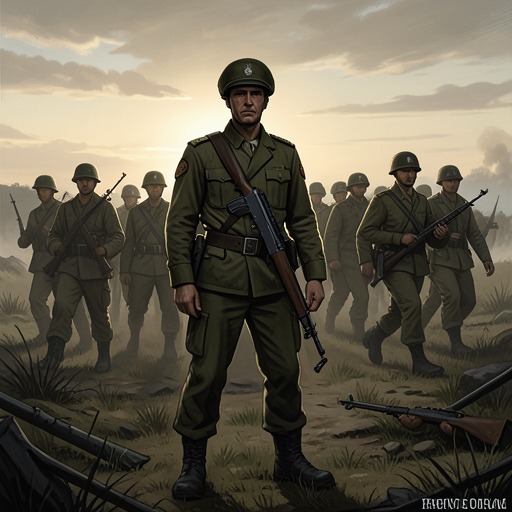
French Ground Army
The Day of the JackalThe French Ground Army stands at the center of the novel’s conflict between military loyalty and civilian authority. It is shown not as a single-minded political actor but as an institution divided by war, rank, experience, and competing ideas of France: soldiers who expect the government to uphold French rule in Algeria confront a president who chooses a different course, and some turn their military allegiance into an armed revolt.
Identity and Reach
The army’s reach in the story extends from colonial battlefields to the political crisis at home. Its personnel include conscripts, professional soldiers, officers, and senior non-commissioned officers, whose different experiences shape how they respond when loyalty is tested. The narrative contrasts conscripts who leave their barracks during the 1961 mutiny with seasoned troops who stay beside their commanders. Military service is also represented through families: a telegram informs the Dumas family that Jean-Claude, a private in the First Colonial Paratroops, has been killed in Algeria. His death carries the war into civilian life and becomes a source of enduring political anger for his sister, Jacqueline Dumas.
The army’s professional identity is bound to combat service. Marc Rodin, from a cobbler’s family and with little formal education, transfers to the colonial paratroops because he sees them as the hard-fighting regiments that do the work while the conscript army performs parade-ground drill. Within a year he is a company commander in Indochina; by the end of that campaign he has become a major. After a year in France, he is sent to Algeria. This path gives the novel a concrete measure of how military status can be earned through combat, while also placing Rodin’s political outlook in the context of prolonged overseas war.
Colonial War and Military Outlook
Rodin’s experience in Indochina turns disappointment into a lasting grievance. He blames politicians and Communists for France’s withdrawal and regards the outcome as a betrayal of the soldiers who died there. In his view, soldiers are the people who sacrifice themselves so civilians can live in comfort; he resents learning, after years of combat, that civilians at home do not share his reverence for the military. The narrative connects that resentment to his own limited opportunities and presents it as a source of his political zealotry, not as a position shared by every soldier.
In Algeria, Rodin first fights the irregular soldiers of the National Liberation Army in the countryside and then takes part in the city war, where plastic bombs are planted in places patronized by French civilians. His harsh measures in Constantine earn him the name Butcher in the Casbah. He treats the military objective as achievable if Paris supplies more support, discounting the war’s costs, France’s strained economy, and the demoralization of conscripts. The gap between his confidence in military victory and the mounting political and practical obstacles helps explain why Charles de Gaulle’s eventual policy reversal strikes him with such force.
Political Division and the 1961 Mutiny
When Charles de Gaulle returns to power in 1958, Rodin initially believes that a soldier-led restoration of France will bring fuller support for the army and for French Algeria. The president’s eventual movement toward negotiations with the FLN contradicts that expectation. Rodin first interprets the change as a tactic; when he accepts that Charles de Gaulle does not intend to preserve French rule in Algeria, his faith collapses into hatred. He leads nearly his entire battalion into the April 1961 putsch.
The failed mutiny reveals that the army’s political allegiance cannot be secured by its commanders alone. In the weeks before the crisis, simple transistor radios have been distributed to troops and regarded as harmless comforts. When the army’s loyalty is put to the test, conscripts across Algeria hear Charles de Gaulle’s appeal directly. The radio, an ordinary item issued to ease the boredom of barracks life, becomes the channel through which presidential authority reaches soldiers over the heads of rebellious officers. Some battalion commanders wake to find that most of their officers and sergeants have left them.
Rodin retains 120 officers, non-commissioned officers, and enlisted men. His unit has a higher proportion of experienced soldiers from Indochina and the Algerian countryside than most, a difference the account identifies as one reason for their continued loyalty to him. This is a remnant, not the whole army: alongside other putschists, it forms the Secret Army Organisation, pledged to overthrow Charles de Gaulle. The transition marks the point at which a military revolt becomes an underground political struggle.
From Army Service to Underground Conflict
The novel traces a boundary between the army and the Secret Army Organisation even as former soldiers carry their discipline, experience, and command relationships into the latter. Rodin becomes deputy to Antoine Argoud, the OAS operations chief in exile. Argoud supplies flair and inspiration to the campaign, while Rodin contributes organization, cunning, and practical judgment. Their division of labor makes the former officer more than a battlefield commander: he becomes an organizer of operations against the government he once expected to support the army.
The wider political campaign also exposes the limits of military power. The OAS combines violence with diplomacy and public relations; Antoine Argoud arranges European media interviews for Georges Bidault, the head of its political wing, to present opposition to Charles de Gaulle in more respectable terms. Meanwhile, the underground’s finances and contacts weaken, safe houses are raided, and supporters withdraw after Argoud’s capture. In an OAS leadership discussion, Marc Rodin argues that conventional plans have become too vulnerable to leaks to be trusted. The army’s capacity for organized action has not disappeared, but it now operates within a clandestine movement facing infiltration and dwindling support.
The consequences return to the military institution through punishment and deterrence. After another plot against Charles de Gaulle is uncovered, he attends a military ceremony at the appointed time but arrives in an armored car, despite his distaste for doing so. The Supreme Military Court sentences Jean-Marie Bastien-Thiry and others to death; Charles de Gaulle commutes two sentences to life imprisonment, but leaves Bastien-Thiry’s condemnation in place. The proceedings show the state using military justice against conspirators drawn from a political and military conflict, while the execution intensifies the underground’s difficulties rather than resolving them.
Narrative Significance
The French Ground Army matters not simply as the source of trained personnel but as the institution through which the novel tests rival claims to national loyalty. Rodin’s career links Indochina, Algeria, the putsch, and the OAS: each stage carries the memory of the previous one forward, until a professional soldier’s devotion to the army becomes opposition to the government. Yet the 1961 radio appeal and the departure of many officers and sergeants show that this transformation is neither automatic nor universal. The army remains divided, and the soldiers who follow Rodin are a determined minority whose experience gives the underground both capability and a continuing grievance.